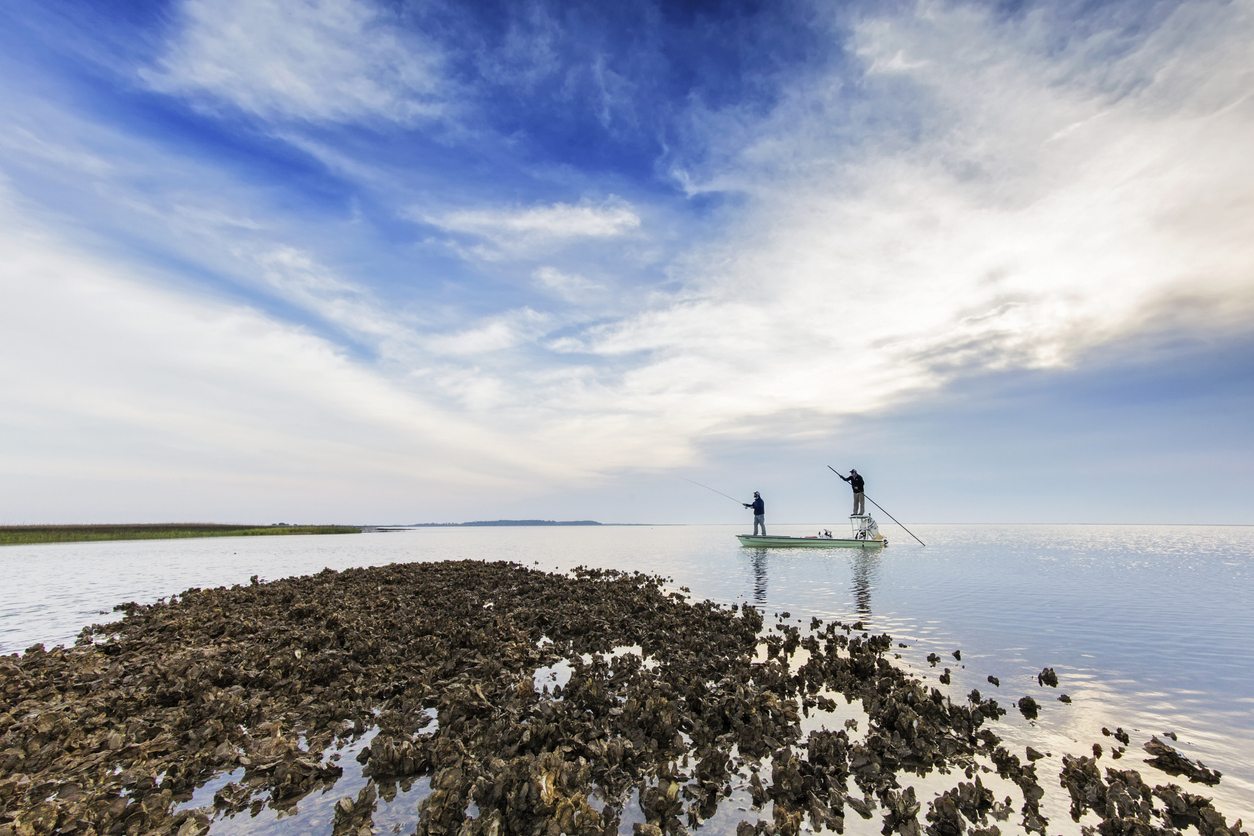
When most anglers think about saltwater fly fishing in the Southeast, Florida is usually the first destination that comes to mind. The Florida Keys, Everglades, and Gulf Coast have earned their reputations as world-class fisheries, offering opportunities to target everything from bonefish and permit to tarpon, snook, and redfish.
But a few hours north of the Florida border, Charleston, South Carolina, offers a completely different saltwater fly fishing experience.
Instead of expansive tropical flats and mangrove shorelines, Charleston's fishery is defined by winding tidal creeks, sprawling spartina marshes, oyster-lined banks, and shallow flats that change dramatically with the tides.
It's a place where anglers can stalk redfish in water barely deep enough to cover their backs, watch copper tails wave above flooded grass, and experience some of the most technical sight fishing on the East Coast.
For anglers who enjoy the challenge of hunting individual fish in shallow water, Charleston fly fishing deserves a place alongside Florida's most celebrated destinations.
Although Charleston and Florida share several popular gamefish species, the environments in which anglers pursue them can be remarkably different.
Florida's saltwater fly fishing opportunities vary significantly by region. In the Keys, anglers pole expansive flats searching for bonefish, permit, and tarpon. Along the Gulf Coast, shallow bays, mangrove shorelines, and grass flats provide habitat for redfish, snook, and other species. Farther north, Florida's marshes and estuaries begin to resemble the fisheries found in coastal Georgia and South Carolina.
Charleston offers a more concentrated Lowcountry marsh experience.
Our fishery revolves around a complex network of tidal rivers, creeks, oyster bars, mud flats, and spartina grass. Rather than focusing on a large variety of species throughout the year, much of our fly fishing is centered on one exceptional gamefish: the redfish.
That specialization is part of what makes Charleston unique.
Redfish are available throughout the year, but their behavior, habitat, and feeding patterns change considerably with the seasons.
For fly anglers, this creates a fishery that constantly rewards observation, patience, and adaptability.
One of the most obvious differences between fly fishing in Charleston and much of southern Florida is the landscape.
The Lowcountry is dominated by vast expanses of smooth cordgrass, commonly called spartina.
These marshes stretch across thousands of acres, intersected by tidal creeks and shallow waterways.
Twice each day, the tide transforms this environment.
An exposed mud bank can disappear beneath several feet of water. A shallow creek can become accessible to feeding fish. During sufficiently high tides, redfish can move into grass flats that were completely dry just hours earlier.
This creates a constantly changing fishery.
Instead of simply identifying productive water, anglers must understand when that water becomes accessible and how fish use it during different stages of the tide.
For me, that's one of the most interesting aspects of guiding in Charleston.
We're not just looking for redfish.
We're trying to understand how they move through the marsh.
If there's one experience that separates Charleston from many other saltwater fly fishing destinations, it's targeting tailing redfish in flooded spartina grass.
During certain higher tides, water rises enough to cover shallow grass flats that are normally exposed.
Redfish move onto these flats in search of crabs, shrimp, and other prey.
As they feed, they often tip downward, exposing their tails above the surface.
Sometimes you'll see a single tail waving between the grass.
Other times, you'll notice a fish pushing water as it moves through an opening in the spartina.
The challenge is getting close enough to make a presentation without alerting the fish.
A tailing redfish may be feeding in only a foot of water, surrounded by grass that can easily catch a fly line or leader.
The cast needs to be accurate.
The fly needs to land quietly.
And the retrieve needs to match the fish's behavior.
Unlike blind casting along a shoreline, flood tide fishing allows you to watch the entire interaction unfold.
You see the fish.
You make the cast.
You watch it react.
And if everything comes together, you see the fish eat.
It's one of the purest forms of sight fishing I've experienced.
Florida also offers excellent tailing redfish opportunities, particularly in its northern marshes and shallow grass flats. But Charleston's extensive spartina habitat and distinctive tidal patterns make this style of fishing a defining part of the Lowcountry experience.
One of the greatest strengths of Charleston's fly fishing is the opportunity to target redfish throughout the year.
While many destination fisheries are heavily influenced by seasonal migrations, Charleston maintains a resident population of redfish that provides opportunities in every season.
That doesn't mean every month fishes the same.
In fact, the seasonal differences are what make the fishery so interesting.
During the colder months, redfish often gather into large schools across shallow flats.
Water clarity improves considerably as temperatures fall and biological activity decreases.
On calm, sunny winter days, anglers may spot entire groups of fish moving across a flat.
These fish can be extremely wary.
A poorly placed cast, excessive boat noise, or sudden movement can spook an entire school.
Winter fishing requires stealth, accurate presentations, and patience.
For experienced fly anglers who enjoy technical sight fishing, it can be exceptional.
As water temperatures begin rising, bait becomes more active and redfish gradually spread throughout the estuary.
Spring brings opportunities to target fish around oyster structure, shallow banks, and tidal creeks.
Higher tides also begin creating opportunities for redfish to enter flooded grass.
It's a transitional season, but one that can produce outstanding fishing.
Summer is when Charleston's flood tide fishery really comes into its own.
The marsh is green, the days are long, and redfish take advantage of abundant food throughout the estuary.
Early mornings can provide excellent sight-fishing conditions before the heat becomes intense.
When the right tides align, we can spend our time looking for tailing redfish in flooded grass.
Summer also brings seasonal opportunities for other species, including tarpon, jacks, triple tail and Spanish mackerel.
October and November are among my favorite months to guide.
Water temperatures begin cooling, bait remains abundant, and redfish feed throughout the marsh.
As fall progresses, fish increasingly begin grouping together, and water clarity can improve.
This creates a transition between the warm-season patterns of summer and the schooling behavior associated with winter.
Comfortable temperatures make the experience even better.
Redfish are found throughout much of Florida's coastal waters, and some of the state's fisheries are among the best anywhere.
The biggest difference isn't necessarily the fish.
It's the environment and the way we target them.
In Charleston, much of our fishing takes place from a shallow-draft poling skiff.
We quietly move through shallow water, looking for individual fish or groups of redfish before making a cast.
The marsh is relatively enclosed in many areas, with oyster banks, creek edges, and grass creating natural feeding zones.
In Florida, redfish habitat varies widely.
Anglers might target fish across expansive grass flats, along mangrove shorelines, in coastal lagoons, or around oyster bars.
Both destinations offer outstanding opportunities.
But Charleston's combination of spartina marsh, substantial tidal movement, and seasonal redfish behavior gives the Lowcountry a distinctive character.
For anglers who enjoy stalking fish in shallow water, it's an incredibly rewarding place to fish.
Tides influence saltwater fly fishing almost everywhere, but they play an especially important role in Charleston.
The difference between high and low water can dramatically change which areas are accessible to redfish.
During lower tides, fish may concentrate along creek edges, oyster structure, or shallow flats.
As water rises, they gain access to additional feeding areas.
At certain higher stages, redfish can move into flooded grass that is otherwise completely inaccessible.
As the tide falls, fish retreat toward deeper channels and creeks.
Understanding this movement is a major part of consistently finding fish.
It's also why I rarely recommend choosing a charter departure time based solely on convenience.
The best fishing window may occur early in the morning, in the middle of the afternoon, or during a particular tide stage.
When planning a Charleston fly fishing trip, the tide is often more important than the time on the clock.
One of the things I enjoy most about guiding for redfish is how closely the experience resembles hunting.
We're not making hundreds of casts hoping something bites.
We're searching.
Sometimes we're looking for a wake moving along a grass edge.
Sometimes it's a shadow on a shallow flat.
Other times, it's the unmistakable tail of a redfish feeding in the spartina.
Once we locate a fish, the challenge becomes approaching quietly and positioning the boat for a presentation.
The fish may change direction.
The wind may shift.
The casting angle might be difficult.
And sometimes, even when everything seems perfect, the fish simply refuses the fly.
That's part of what makes sight fishing so addictive.
Every fish presents a different challenge.
And every successful presentation feels earned.
Not necessarily.
Although Charleston offers some very technical sight fishing, anglers don't need to be experts to enjoy the experience.
Many redfish opportunities occur within 30 to 50 feet of the boat.
Accuracy and the ability to make a quick presentation are often more valuable than extreme casting distance.
If you're preparing for a trip, I recommend practicing with an 8-weight fly rod and focusing on short, accurate casts with minimal false casting.
Being comfortable casting in the wind is also extremely helpful.
For beginners, a guided trip offers the opportunity to learn about fish behavior, casting angles, fly presentation, and how to identify redfish in shallow water.
For experienced anglers, Charleston provides the challenge of targeting wary fish in a constantly changing environment.
While redfish are the foundation of Charleston's fly fishing, they're not the only species available.
During the warmer months, migratory tarpon move through South Carolina's coastal waters.
These fish offer an entirely different challenge and can provide opportunities for anglers interested in pursuing larger saltwater gamefish.
Speckled trout are also common throughout the estuary, and seasonal opportunities exist for species such as tripletail and cobia.
However, anglers whose primary goal is to target permit, bonefish, or snook should generally look toward Florida or other destinations where those species are established targets.
Charleston isn't a replacement for every Florida fishery.
It's a destination with its own strengths.
And for anglers who love redfish, those strengths are significant.
One advantage of choosing Charleston for a fly fishing vacation is everything available away from the water.
Charleston is one of the Southeast's most popular destinations, known for its historic architecture, restaurants, beaches, and coastal scenery.
For anglers traveling with family or friends who don't fish, that can make planning a trip much easier.
You can spend the morning poling a quiet marsh looking for redfish and still have the afternoon or evening to enjoy the city.
Visitors staying on Kiawah Island, Folly Beach, Isle of Palms, Sullivan's Island, or in downtown Charleston have access to an incredible coastal environment.
That combination of world-class sight fishing and a great destination off the water makes Charleston especially appealing for anglers planning a family vacation or a shorter fishing getaway.
The answer depends on the experience you're looking for.
Choose Charleston if you want:
Choose Florida if you want:
Neither destination is inherently better.
They offer different experiences, and both deserve a place on a saltwater fly angler's list.
I've spent countless hours poling through Charleston's marshes, and one of the things I appreciate most is that no two days are exactly alike.
The tide changes.
The wind changes.
The fish move.
A flat that was productive yesterday might be completely different today.
And every once in a while, everything comes together.
You're standing on the bow of the skiff.
The marsh is quiet.
There's a redfish tailing 40 feet away in the grass.
You make the cast, watch the fly settle, and see the fish turn toward it.
That's the moment.
It doesn't matter how many redfish you've caught before.
Watching one eat your fly in shallow water never gets old.
Florida will always be one of the world's great saltwater fly fishing destinations.
But if you've never experienced the spartina marshes of Charleston, you're missing a completely different side of the sport.
And it's one that's worth traveling for.
At Tailfin Expeditions, we specialize in guided fly fishing and light-tackle charters throughout Charleston's Lowcountry, with a particular focus on sight fishing for redfish.
Whether you're an experienced saltwater angler looking for technical fishing or someone hoping to catch their first redfish on fly, we'll plan the trip around your experience level, the tides, weather, and seasonal fishing conditions.
We offer half-day, three-quarter-day, and full-day charters, giving anglers the flexibility to build a trip around their goals.
If you're considering Charleston for your next saltwater fly fishing trip, I'd love to show you what makes this fishery different.
Explore Charleston Fly Fishing Charters
Or reach out to discuss the best time of year to experience Charleston's redfish fishery.


A deposit of $200 will be required to hold your dates. Deposits are refundable up to 7 days prior to your trip or if the weather does not allow us to get out. Payment in full is due the day of the trip. Cancellations within 48 hours of the trip are subject to full payment. Acceptable forms of payment include; credit/debit card, Venmo, check or cash.
Book Your Trip Now