.png)

If you’ve ever spent a day casting without knowing what’s actually in front of you, sight fishing redfish feels like a completely different approach.
Instead of guessing, you’re looking for the fish first. Sometimes that’s obvious, like a tail sticking out of the grass. Other times it’s just a subtle push or a shape that doesn’t quite belong.
That shift changes how you fish.
You start paying attention to angles, light, and movement. You think about where the fish is going before you ever make a cast.
And here’s the part most people overlook. This style of fishing has less to do with what you’re throwing and more to do with what you’re noticing.
Once that clicks, everything else starts to make more sense.
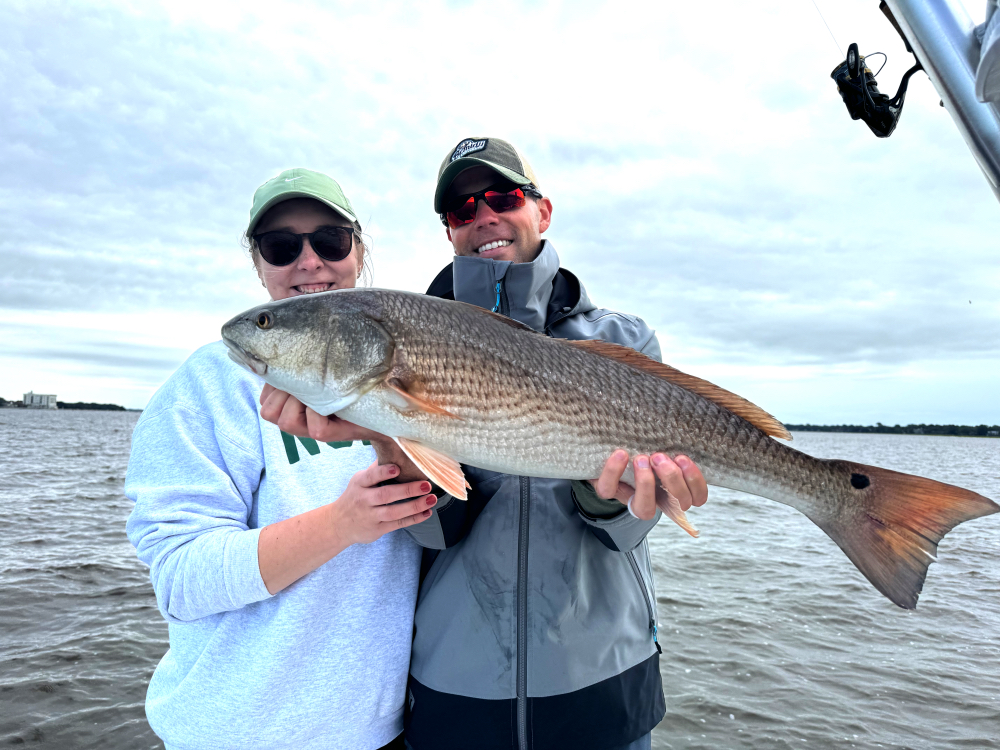
Sight fishing these Charleston SC redfish means targeting fish you can see in shallow water rather than casting blindly and waiting for a bite.
In most types of fishing, you’re covering water and hoping fish are there.
With sight fishing:
That sequence is what makes it challenging and rewarding at the same time.
Redfish spend a lot of time feeding in shallow water. They push into grass, cruise flats, and move predictably with the tide.
Because of that, you’ll often see:
That visibility makes them one of the best species to learn this style of fishing.
Finding fish is the first real hurdle. And most people either overcomplicate it or ignore the one thing that matters most.
If you remember one thing, make it this.
Redfish don’t sit still. They move with the tide.
You’re not just looking for fish. You’re looking for where they should be based on water movement.
There are a few places that consistently produce:
In Charleston, these areas shift day to day depending on wind, tide timing, and water clarity. That’s why local knowledge plays such a big role.
If you want to shortcut the process, spending time on a Charleston fishing charter can help you understand how those pieces fit together.
One of the biggest mistakes anglers make is focusing on locations instead of conditions.
A good flat on the wrong tide is just empty water.
A simple creek edge at the right moment can be full of fish.
This is where most people struggle, and it has nothing to do with casting.
Sometimes you’ll see the whole fish. Most of the time, you won’t.
You’re really looking for clues:
It’s not always obvious. That’s why it takes time.
Your position matters more than most people realize.
Keep the sun at your back whenever possible. That angle reduces glare and gives you depth.
If the sun is in your eyes, you’re working at a disadvantage no matter how good your gear is.
New anglers tend to scan water quickly, expecting something obvious.
That’s not how fish show up.
Instead:
Once you see a few fish this way, it becomes easier to recognize the pattern.
A lot of first-time anglers look right at fish and don’t see them.
I’ll point one out, and suddenly it becomes obvious.
That’s not because the fish changed. It’s because their eyes finally knew what to look for.
Seeing the fish is one thing. Getting the fish to eat is another.
A general rule:
But that’s not fixed. Faster fish need more lead. Slower fish need less.
You’re trying to intersect its path naturally, not drop something on top of it.
Not every redfish reacts the same way.
Watch how it moves before you cast.
This is where a lot of people overdo it.
The fish tells you what it wants. You just have to pay attention.
The most common mistake is rushing the hook set.
Let the fish turn. Come tight. Then set the hook.
It feels like a small detail, but it makes a big difference.
Gear plays a role, but it’s not what separates success from failure.
Most redfish situations call for:
You don’t need a complicated setup. You need one you’re comfortable with.
If you’re not fly fishing:
The same principles apply regardless of gear.
A few things matter more than anything else:
Everything else is secondary.
Redfish are here year-round, but how you approach them changes with the seasons.
Water starts warming up. Fish become more active and spread out.
You’ll see more movement and more opportunities to find fish on flats.
This is when flood tides come into play.
Fish push into flooded grass, and you’ll see classic tailing behavior. It’s one of the most visual and exciting times to fish.
Fish start grouping up more.
You can find larger schools, and the action can be more consistent, especially on lower tides.
This is often overlooked.
Water clears up, and fish become more predictable, but also more sensitive. It turns into a more technical game.
If you want to understand how conditions shift throughout the year, this breakdown of winter fly fishing in Charleston gives a good look at how seasonal changes affect behavior.
Most missed opportunities come down to a few repeat mistakes.
Whether it’s the boat or your eyes, speed works against you.
Slowing down gives you more chances to see fish before they see you.
People often cast as soon as they spot something.
Take a second to read the fish. That extra moment usually leads to a better shot.
Wind and sun matter more than most anglers realize.
Bad angles reduce visibility and control.
More movement isn’t always better.
A lot of fish eat on subtle, natural presentations.
There’s a lot of good information out there, but there are also some patterns worth pointing out.
Gear is easy to talk about, but it’s not the deciding factor.
Awareness, positioning, and timing matter more.
“Look for tails” sounds simple, but it’s not always that obvious.
Learning to see fish takes time and repetition.
Tide, light, and wind all affect how fish behave and how visible they are.
You can do everything right and still struggle if conditions aren’t working in your favor.
Knowing what to do when a fish appears is just as important as finding it.
That’s something you only really learn through experience.
There’s a reason people book trips even if they already fish.
A guide can point out fish you wouldn’t notice on your own.
That alone can change how you approach everything.
Instead of trial and error, you get real-time feedback.
Positioning, casting, reading fish. It all starts to make more sense.
Tide, wind, light, location. Seeing how those connect in real time is hard to learn on your own.
Trips are always tailored to the angler, whether you’re brand new or experienced .
If you’re fishing around the Charleston area, options like Folly Beach fishing charters give you access to some of the best shallow water in the Lowcountry.
The best tide depends on your goal, but moving water is key. Flood tides are great for tailing fish, while low tides can concentrate fish in predictable areas.
Yes, but it takes patience. The hardest part is learning to see fish, not casting to them.
Simple, natural presentations work best. Matching the environment matters more than using anything complicated. By knowing what bait is around can help dictate which fly or lure to use, but also the water clarity plays a big role in the color I use. With our dirtier water in the summer I tend to fish black or purple/black flies because they show up better in those conditions. The converse to that is the clear water we have in the winter/spring months where a more natural looking fly/lure will produce better.
Usually 2–4 feet in front of the fish. Adjust based on how fast it’s moving and how it’s behaving.
Good light helps visibility, so mornings and afternoons can both work depending on conditions.
It can be at first, but once you understand what to look for, it becomes more intuitive and rewarding.
Sight fishing redfish isn’t the easiest way to catch fish, and that’s part of the appeal.
It forces you to slow down, pay attention, and think through each moment instead of just going through the motions.
At first, it can feel frustrating. You’ll miss fish. You’ll overlook opportunities. Everyone does.
But once you start recognizing the patterns, everything changes.
You stop guessing. You start seeing.
If you want to figure it out faster, spending a day on the water with someone who does this every day can make a big difference.
Either way, the process is what makes it worth it when it comes to fly fishing in Charleston and the low country.


A deposit of $200 will be required to hold your dates. Deposits are refundable up to 7 days prior to your trip or if the weather does not allow us to get out. Payment in full is due the day of the trip. Cancellations within 48 hours of the trip are subject to full payment. Acceptable forms of payment include; credit/debit card, Venmo, check or cash.
Book Your Trip Now